With the advancement of technology, many applications have surprised users by offering powerful features with just a few taps on the screen. A clear example of this is AI apps for photos, who can restore old photos or damaged with impressive results.
These tools have become increasingly sought after by people who want to relive memories stored in old albums or low-quality scans. As a result, several options have emerged that use artificial intelligence for photos and offer professional features, all conveniently on your cell phone.
Discover how to restore old photos with your cell phone
First of all, it is worth mentioning that the applications available in the app stores feature cutting-edge technology. Most of them use AI for old images and algorithms trained to automatically detect cracks, noise, fading and other common damage.
Additionally, many of these apps are available on PlayStore, and offer both free versions and premium features. So if you want download photo app and start recovering your most beloved images, keep reading and see the best options.
1. Remini – AI Photo Enhancer
O Remini is one of the most popular applications in the world when it comes to improving image quality. It uses one of the most advanced artificial intelligence for photos on the market, managing to transform low-resolution images into true digital works of art.
With Remini, it is possible not only restore old photos, but also enhance selfies, portraits, family photos and even damaged images. Therefore, when free download With this app, you are guaranteed a powerful resource to relive your memories with impressive realism and clarity.
2. PhotoTune – AI Photo Enhancer
Another application that deserves to be highlighted is PhotoTune. It allows you to recover old photos With just a few taps, AI is used to automatically enhance faces, details, and colors.
The difference with PhotoTune is its ease of use. Even those with no experience in image editing can achieve incredible results. If you are looking for download app for damaged photo, this is one of the best choices available.
3. Face Restore – Old Photo Repair
O Face Restore is ideal for those who want to recover old portraits of family members, especially black and white photos. It is designed to deal with old images that have lost quality over the years, using AI photo restoration to bring sharpness, color and definition back.
To the download image restoration app With this feature, users can experience the thrill of seeing an old face come to life again. It is also compatible with a variety of image formats, making it even more useful in everyday life.
4. Colorize – Color to Old Photos
The application Colorize is perfect for those who want to go beyond restoration. With it, you can colorize old photos in black and white with stunning realism. Its artificial intelligence for photos automatically detects areas of the image and applies colors consistent with the context of the photo.
Additionally, it also offers the option to improve sharpness, remove noise, and correct skin tones. If you are looking for a app that enhances photos and brings old memories to life, this is an excellent alternative to do the download right now.
5. Snapseed com Filtros de Restauração
Although the Snapseed is best known for its creative edits, it can also be used as a application to recover old photos, mainly with the use of specific filters for image correction.
The great thing about Snapseed is its intuitive interface and the depth of free features available. Not only does it allow you to restore old photos, but also allows fine adjustments to remove blemishes, restore colors and highlight details that were previously erased.
Extra features that make a difference
While restoration is the main focus of these apps, many of them have additional features that make the process even more interesting. For example, some apps allow you to turn the restored image into an animated video, or even apply nostalgic filters to maintain the classic look of the original photo.
Additionally, there are features such as high-resolution export, direct sharing to social networks, and even integration with cloud services. This ensures a practical and modern experience, even when dealing with memories from the past. If you want a application to recover photos with extra functions, these details can be decisive when making your choice.
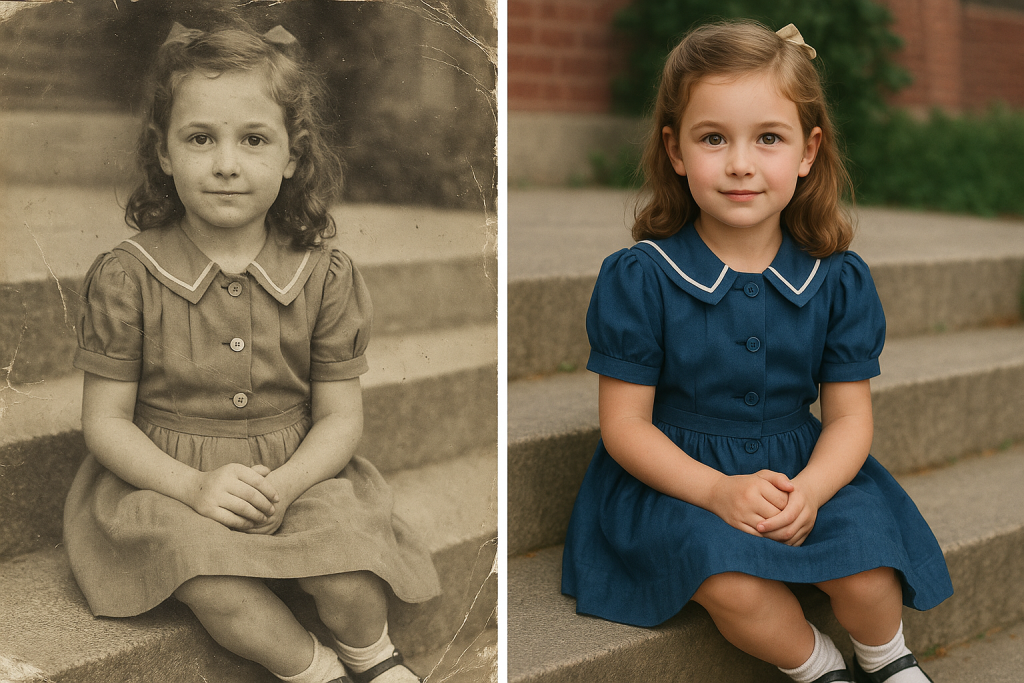
What does artificial intelligence actually do when it "retrieves" a photo?
It's important to understand the mechanics before expecting miracles. These applications don't retrieve information that has disappeared from paper or files: they use a model trained on millions of images to... to rebuild what would probably be there.. The result is a plausible reconstruction, not a recovery of what existed. Where the original has no data, the machine fills in the gaps with the most common pattern it has learned.
In practice, this means that personal features can be lost. A scar, a birthmark, the exact shape of an old relative's nose or teeth can be replaced by an "average" version of a human face. That's why many people look at the restored photo and feel that the person looks similar, but it's not exactly them.
The practical conclusion is simple: Never delete the original file.. Treat the generated version as an enhanced copy for display and sharing, and keep the raw scan stored away. For documents, historical records, or any use where fidelity matters, the original is what counts.
Before uploading your family photo to an unknown server
A large portion of this category processes the image in the cloud, meaning the photo is taken from your phone and sent to a company's server. This isn't necessarily a bad thing, but it changes what you need to check before installing.
- Where the processing takes placeIf it's local, it works without internet; if it's in the cloud, your image travels.
- What do the terms of use say? Regarding the licensing of the uploaded images and how long they are stored.
- If account deletion occurs and files within the application itself.
- The permissions requestedOn recent Android devices, it's possible to unlock only selected photos instead of the entire gallery, while on iPhones there's an option to access specific photos.
- What the free plan offersWatermarks, locked resolution, and daily limits are common, and sometimes the subscription is weekly disguised as a trial.
There is also the issue of image rights, which the LGPD (Brazilian General Data Protection Law) reinforces: a photograph of a face is personal data. Uploading and especially publishing the image of a third party, including a child or a deceased relative, is a decision that involves the family. It's better to agree on it beforehand than to find out later that someone didn't want it circulating.
Step-by-step guide to digitizing and processing without damaging the material.
- 1. Photograph the printed photo with diffused, indirect light, never with a direct flash, which overexposes the image and creates reflections.
- 2. Use a scanning app with perspective correction to straighten the edges.
- 3. Save this raw file in a separate folder and back it up before making any edits.
- 4. Crop, rotate, and adjust the framing before applying automatic restoration.
- 5. Apply the highlight once and compare at 100% zoom before accepting.
- 6. Export at the highest available resolution and save both versions, the original and the processed version.
The two most common mistakes are: the first is stacking processes: applying improvements, saving, applying again to the result, and repeating, which accumulates artifacts and leaves the skin looking plastic. The second is relying on colorization as if it were real information: the color of the clothing, eyes, and background is a statistical guess of the model, not the true tone of that day.
The honest limits of automatic restoration.
A blurry photo caused by movement doesn't become a sharp photo. Motion blur erases information, and what artificial intelligence does is draw realistic outlines over it—which may be wrong. The same applies to a torn piece, a large damp stain, and a sunburnt area: the filling in is a polite invention.
Increasing the resolution doesn't create true detail either. A small image that is rescaled becomes larger in pixels, but the amount of actual information remains the same. For large print runs, the gain is limited and depends heavily on how sharp the original already was.
What your phone can already do without installing anything and frequently asked questions.
The Google Photos editor, present on most Android devices, offers cropping, light adjustment, shadows, sharpening, and element removal, in addition to saving deleted items in the Trash for about sixty days. On iPhone, the Photos app edits non-destructively, with the option to revert to the original at any time, and keeps items in Recently Deleted for about thirty days.
Dá para recuperar uma foto com um pedaço faltando?
It's possible to fill the gap with something coherent, which solves the visual problem. But what appears there is a creation of the model, not the content that existed. If that section had a face, the generated face is not the person.
A colorização acerta a cor real da roupa?
No. She chooses statistically probable colors for skin, sky, vegetation, and fabric. It looks nice, but it's not an accurate record of what it was like.
Preciso de internet para usar?
It depends on the application. Those that process locally work offline; those that use a server require a connection and send their image outside the device.
Vale pagar por esse tipo de aplicativo?
This is useful when you have a large batch of photos and want to export them without watermarks in high resolution. Beforehand, check the total cost of the plan and how to cancel the subscription in the store itself.
Conclusion
In summary, the apps with artificial intelligence that restores photos are revolutionizing the way we handle old images. With just a few taps, you can relive precious memories, enhance details, and share moments with family and friends that seemed lost in time.
If you want download photo app with professional quality, without needing technical knowledge, it is worth exploring these options. And as we mentioned throughout the article, all of them are available to free download from PlayStore, with versions that cater to beginners as well as the most demanding users.
Don't waste time! Choose your favorite, do the download now and rediscover your memories with the help of technology. After all, each restored image is a recovered emotion. 📸✨