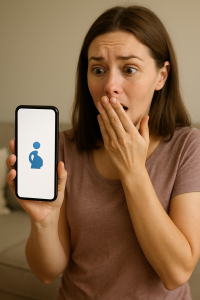
Menstrual cycle tracking apps are useful, popular, and reasonably accurate in what they set out to do. What they... no What they do is detect pregnancy — and this distinction is often lost in the titles circulating online. It's worth opening the box and understanding exactly what these apps do.
This text explains the calculations behind the predictions, where it gets it right, where it gets it wrong, what the advanced features add, and how to use the app to know the right time to take a real test.
The account that's behind it
You enter the first day of each period. With two or three entries, the app calculates the average length of your cycle — the distance between the first day and the next.
From there, it projects: next expected menstruation on the current date plus the average duration. It's simple arithmetic, and it's honest as long as it's presented as a prediction.
The fertile window comes from a second calculation. The phase between ovulation and the next menstruation, called the luteal phase, is relatively stable—around two weeks in most people. The app then subtracts this period from the next expected menstruation to estimate ovulation, and marks a few days before it because sperm survive for some time in the reproductive tract.
It is worth highlighting the word estimate. No app detects ovulation from the data entered; it deduces it from an average.
Where the calculation is correct
- Regular cycles. With little variation between months, the expected date of menstruation tends to fall very close together.
- Long history. The more months recorded, the better the average and the less weight an atypical month has.
- Identify the delay. This is the most valuable and least discussed feature: the app accurately tells you how many days have passed since the expected date — information that is difficult to reconstruct from memory.
- Symptom pattern. By tracking several cycles, it becomes clear what is typical for your premenstrual phase and what is new.
Where the calculation goes wrong
- Irregular cycles. If the duration varies significantly between months, the average loses its meaning and the forecast becomes a guess.
- Unusual months. Intense stress, illness, travel with time zone changes, sudden weight changes, and strenuous exercise can all disrupt ovulation—and the app has no way of knowing this.
- First few months of use. Without a history, the app assumes a default 28-day cycle, which may not be yours.
- Adolescence and perimenopause. Phases in which irregularity is expected and forecasting is unreliable.
- Use of hormonal contraceptives. The bleeding is induced by the pause, it does not reflect a natural cycle, and the logic of the fertile window does not apply.
One important practical consequence: The cycling app is not a method of contraception.. Fertility awareness-based methods exist and are legitimate, but they require formal training, daily observation of temperature and mucus, and specific rules—far beyond a prediction based on averages.
What do advanced features add?
Temperatura basal
Body temperature at rest rises slightly after ovulation, due to the action of progesterone. Measured every day at the same time, before getting out of bed, it confirms It shows that ovulation occurred—but only after the fact. It's not a reliable way to predict it.
Observação do muco cervical
Its consistency changes throughout the cycle and it's one of the signs used in fertility awareness methods. Interpreting it requires learning.
Testes de ovulação
These strips detect the LH hormone peak in urine, which precedes ovulation by about a day. This is measured data, not estimated—but it comes from a strip, not a cell phone. The app only records the result.
Registro de sintomas
Most useful in daily life. Noting cramps, mood, sleep, flow, and pain with dates builds a history that is excellent reference material — especially when investigating irregular cycles or intense pain.
Why doesn't the app detect pregnancy?
Confirmation of pregnancy depends on finding the hCG hormone, produced after implantation. Detecting it requires a sample: urine, in a pharmacy test, or blood, in a beta-hCG test.
The phone doesn't have a sensor that interacts chemically with anything. What the app does is perform arithmetic on dates you've entered, and arithmetic doesn't find hormones. When an app indicates a delay, it's saying that the expected date has passed—which is a great reason to take the test, not a result.
How to use the app to decide when to take the test.
- Record the first day of each menstrual period for several months without fail. The accuracy of the prediction depends entirely on this.
- When the app indicates a delay, check how many days it is.
- Starting from first day of delay, This way, the urine test becomes reliable. Use the first urine of the day.
- If the result is negative and the delay continues, repeat the test in three to five days.
- A delay of more than two weeks with a negative test: seek evaluation.

Privacy, which is what matters here.
Cycle data is health information. Before choosing, it's worth checking if the app allows password or biometric access, what it shares for advertising or research purposes, and if you can export and delete your data. Reputable apps answer these three questions clearly.
SEE MORE:
Before installing: what to look for in a cycling app
The choice here isn't about which app has the prettiest screen. It's about what it does with data that describes your reproductive health. Before creating an account with any app, check its listing in the official app store and its privacy policy, and see who the developer is, if there are recent updates, how the app is maintained, and if there's a clear button to export and delete everything you've recorded.
- Permissions requested on initial openingA cycle log requires storage and, at most, notification. Contacts, SMS, calls, microphone, and precise location have no function here.
- Offline operationIf the app opens and calculates without a connection, it means the calculation is happening on the device, and not on a server that stores a copy.
- Size and weightA cycle diary fits in a few tens of megabytes. A very large installer usually loads advertising and tracking libraries.
- Ad volume: Cross-screen advertising is acceptable; full-screen ads on every tap disrupt daily logging and make you give up on taking notes.
- Readable data policyIf the text doesn't say with whom the data is shared and for how long it is stored, consider that an answer.
The business model explains almost everything. There's the free app with advertising, there's the subscription-based one, and there's the one that doesn't show ads or charge, and it's precisely this third one that deserves the toughest question: if you don't pay and you don't see ads, what's paying the server bill? The answer isn't always bad, but it needs to be written down somewhere.
The first thirty days of use, in the correct order.
A cycle app only becomes useful after it accumulates its own data. In the first few months, it works with a generic average of twenty-eight days, which is a good starting point and is quite inaccurate for those with shorter or longer cycles. The sequence below shortens this calibration period.
- 1. Install from the official system store and deny any permissions other than storage and notification.
- 2. On the first screen, enter the start date of your last menstrual period, not the date it ended — the start of the flow marks day 1 of the cycle.
- 3. If you know the duration of the last three cycles, enter it manually instead of accepting the default of twenty-eight days.
- 4. Set the notification to a time when you usually have your phone in your hand, and choose a discreet text option if other people see your lock screen.
- 5. Record the first and last day of each flow for three consecutive cycles, without skipping any. This trio is what transforms the generic forecast into your own forecast.
After that, the daily effort drops to just a few seconds. The record that most changes the quality of the prediction remains the simplest: the start date of the flow. Symptoms, mood, and intensity add context to the consultation, but it is the first day that feeds the calculation.
Common mistakes people make when tracking their menstrual cycle on their cell phone.
The most frequent mistake is treating the predicted date as if it were confirmed information. The screen shows an exact day because a full date is easier to plot than a probability range, but what lies behind it is a statistical estimate. Stress, travel, changes in sleep patterns, weight fluctuations, illness, and starting or stopping medication can shift ovulation and, with it, everything that follows.
The third is using the app as a contraceptive method. No calendar app is a contraceptive. It does not prevent pregnancy, does not replace condoms, pills, IUDs, or implants, and the failure rate of the calendar method alone is high enough that no medical society recommends it on its own. Contraceptive methods are chosen during a consultation, and many of them are distributed free of charge in the public health system.
Menstrual data is sensitive data: what Brazilian law guarantees you.
The General Data Protection Law classifies information about health and sexual life as sensitive personal data, a category with stricter rules than those applied to names and email addresses. Records of menstruation, attempts to conceive, and symptoms fall precisely into this category. Processing this type of data requires specific and prominent consent, that is, a separate and clear authorization, not a hidden line in a generic terms of use agreement.
The same law lists the rights you can exercise against any company that keeps these records: confirm that processing exists, access what has been stored, correct incomplete or incorrect data, request portability, revoke consent, and demand the deletion of data processed based on it. The request is made to the controller — the app developer — and they need to provide a channel for this, usually an email address in the privacy policy.
In practice, do it in this order: export your history first, so you don't lose your own record; then delete the account within the app, not just the icon on your phone. Uninstalling removes the program from the device and doesn't affect what's on the server. If the app doesn't have an option to delete the account, requesting it via email based on the law is the way to go, and it's worth keeping proof of sending it.
What the cell phone already solves without an extra app.
On iPhones, the Health app has its own cycle tracking section, which stores dates and symptoms within the system, protected by the same passcode and biometric authentication as the device. On Android, the Health Connect platform acts as a central health data vault: apps request permission to read or write there, and you can view and revoke these permissions in one place, without having to access each app individually.
If the intention is simply not to miss the date, the native calendar solves that. A recurring event with a reminder, marked as private, provides the practical part of the prediction without revealing anything to anyone. And if the problem is the notification appearing to anyone nearby, both Android and iOS allow you to hide the content of notifications on the lock screen, showing only the app name — or not even that.
Frequently asked questions about cycling apps
Posso usar o aplicativo no lugar do anticoncepcional?
No. The app estimates a fertile period using a calendar calculation; it does not block ovulation, is not a barrier, and does not protect against sexually transmitted infections. Using app prediction as contraception is the riskiest use for this type of program. Contraceptive methods are prescribed during consultations, and many are offered free of charge in the public healthcare system.
Ciclo irregular torna o aplicativo inútil?
As a date predictor, almost. As a diary, no: it is precisely in irregular cycles that continuous recording is most valuable, because it documents the real variation over the months. Bringing this history to the consultation is more useful than describing it from memory, and helps to investigate causes such as thyroid disorders, polycystic ovary syndrome, and medication effects.
O aplicativo consegue perceber que estou grávida?
No. He only sees the absence of a record that you failed to make. Delays can have dozens of causes, and confirmation depends on detecting the hCG hormone — which only happens with a pharmacy urine test or a beta-hCG blood test, the latter being free through the SUS (Brazilian public health system) at basic health units.