
Take care of plants and flowers It can be an extremely rewarding activity; however, correctly identifying each species can be a challenge, especially for beginners. Furthermore, knowing the specific needs of each plant is crucial to ensuring its healthy and lush growth. In this sense, having access to tools and information that facilitate this process is fundamental.
As a result, technological advancements have brought innovative solutions that can help plant lovers. Plant identification apps are excellent allies, providing not only quick identification but also valuable care tips. So, let’s explore some of these tools and how they can transform the way we care for our gardens and houseplants.
Plant and Flower Identification Apps
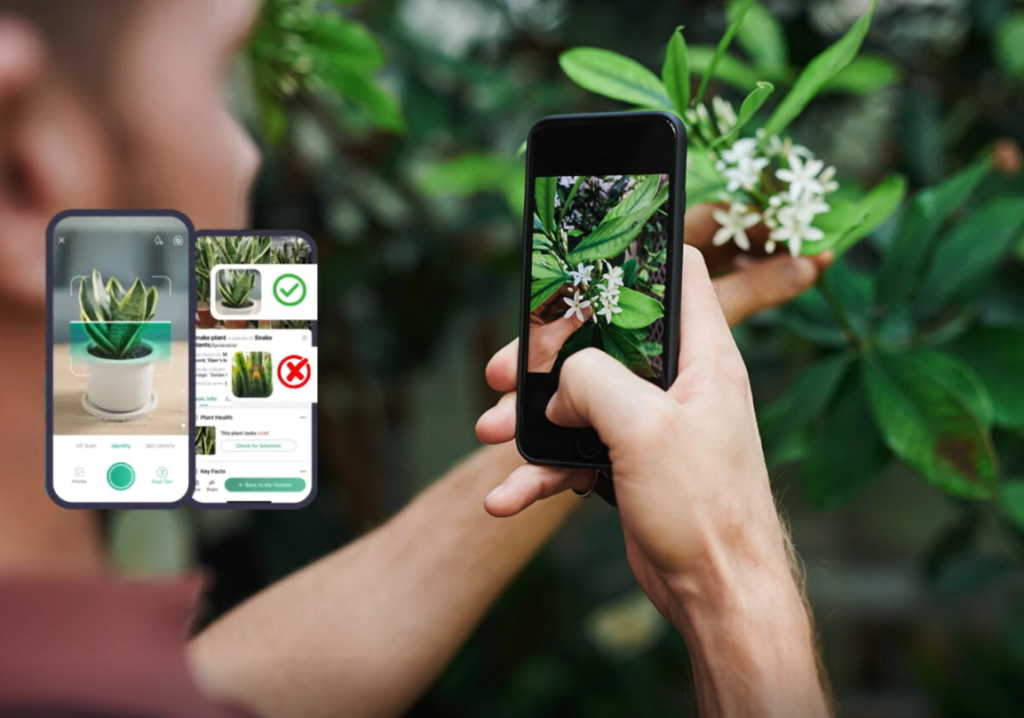
Nowadays, with the proliferation of smartphones, it is possible to carry a digital botanist in your pocket. There are several apps that allow you to identify plants and flowers quickly and efficiently, simply by using your phone’s camera. Below, we will look at some of the most popular apps and how they can be useful.
PlantSnap
PlantSnap is one of the most popular apps for plant identification. With a vast database, it allows you to identify thousands of species of plants, flowers, trees, and even fungi. In addition, the app is extremely intuitive, making it easy to use even for those who are not so familiar with technology.
To start using PlantSnap, simply take a photo of the plant you want to identify. The app then compares it to its database and provides detailed information about the species. It also provides care tips, such as watering, lighting, and soil types, to help keep your plants healthy.
PictureThis
Another popular app is PictureThis. This app stands out for its accuracy in identifying plants and the detailed information it provides. It has an active community of users, allowing you to share photos and exchange experiences with other plant lovers.
Using PictureThis is quite simple. After taking a photo of your plant, the app analyzes the image and provides the name of the species, as well as information about its care. This way, you can learn about the best way to care for each plant, ensuring that they grow healthy and beautiful.
PlantNet
PlantNet is an excellent option for those looking for a free and efficient application. Developed by scientists and botany experts, it has a vast database and is constantly updated. The application also allows users to contribute new information, further enriching its content.
Using PlantNet, you can take photos of plants and compare them to images in the database. The app provides details about the species, including its scientific name, key characteristics, and care tips. You can also explore plants by region, making it easier to identify local species.
Garden Answers
Garden Answers is an app that goes beyond simple plant identification. It offers a number of additional features, such as a Q&A section where you can ask questions to experts. This feature is especially useful for beginners who need more detailed guidance.
To use Garden Answers, simply take a photo of the plant and the app will identify the species. In addition, you can access a vast library of articles on care, pests and diseases, making it a true guide for beginners and experienced gardeners alike. Therefore, it is a complete tool for those who want to take good care of their plants.
iNaturalist
Finally, iNaturalist is an app that combines plant identification with a social network for nature lovers. Created in partnership with National Geographic, it allows you to not only identify plants but also share your discoveries with a global community.
Using iNaturalist is simple and intuitive. After taking a photo of the plant, the app will provide detailed information about the species. In addition, you can interact with other users, share photos and participate in citizen science projects. Therefore, it is an excellent option for those who want to learn more about biodiversity and contribute to collective knowledge.
Additional Application Features
In addition to identifying plants, these apps offer a number of additional features that can be extremely useful. Many of them provide care tips, such as the ideal watering frequency, the most suitable soil type, and the amount of light required. In addition, some apps offer alerts and reminders for plant maintenance, such as pruning and fertilization, making your care routine easier.
Another interesting feature is the possibility of creating a plant diary, where you can record the growth and development of your plants over time. This way, you can closely monitor their progress and quickly detect any problems.
FAQ
How do plant identification apps work? Plant identification apps work by using your phone's camera to take photos of plants. They then compare these images to a species database and provide detailed information about the identified plant.
Are these apps accurate? Yes, most apps have a high accuracy rate, especially those that use artificial intelligence and large databases. However, accuracy can vary depending on the quality of the photo and the plant species.
Do I need to pay to use these apps? Many of these apps offer free versions with basic functionality. However, some advanced features may require a subscription or one-time payment.
Can I use these apps without an internet connection? Most apps require an internet connection to access their databases and provide detailed information. However, some may offer limited offline functionality.
Do the apps provide care tips? Yes, most apps provide care tips, such as information on watering, lighting, and soil types. Some also offer alerts and reminders for plant maintenance.
Why identification fails, and how to reduce error.
The system compares your photo with a huge set of already identified images and returns the most similar species, with a degree of confidence. Because it's a visual comparison, it's very accurate in identifying distinct plants and stumbles precisely where the difference is subtle: species of the same genus, cultivated varieties, and plants that change appearance according to age and season.
- Photograph more than one part.: flower, isolated leaf on a neutral background, stem and the entire plant.
- Get closer and focus., with diffused light; strong sunlight washes out the white of the petals and obscures the detail.
- Avoid polluted background, with several plants together, because the model might analyze the wrong species.
- Please specify the region. When the app allows it, which excludes species that do not occur in that area.
- Compare two suggestions reading the description, instead of accepting the first one on the list.
A low level of confidence should be interpreted as an invitation to investigate, not as an answer. And if you photographed a store-bought ornamental plant, remember that many are selectively bred varieties, with leaves and color altered by cultivation, making recognition difficult even for experts.
Where this identification cannot be used
The rule is simple and has no practical exceptions: app results are not useful for deciding whether a plant can be ingested, applied to the skin, or used as medicine. Toxic plants look like edible ones, and visual similarity is precisely the criterion the system uses. A ninety percent accuracy rate is great for curiosity and terrible for something that ends up in your mouth.
The same applies to improvised veterinary use and to preparing teas with leaves from the backyard. Also, do not use the identification as a basis for uprooting plants from protected areas, for selling seedlings as rare species, or for attesting to the origin of any plant material. The app proves none of that.
Questions that remain after identification.
Funciona sem internet?
Generally not, because the comparison happens on a server. Some allow downloading packages by region for offline use, which is useful on trails. Check this option before relying on it in the middle of nowhere.
As fotos que envio ficam públicas?
It depends on the service. Citizen science platforms publish the records by default, including the location, and this is intentional. Commercial applications usually store the images in a private account, but it's worth reading the policy before photographing the interior of your house along with the floor plan.
Qual permissão esse tipo de app realmente precisa?
Camera and, if you want geographic location tracking, only during use. Contacts, microphone, phone, and total storage are not related to plant identification and should be declined.
Conclusion
In short, quickly identifying any plant or flower and getting care tips has become much easier with the help of specialized apps. Not only do they make identification easier, but they also offer a number of additional features that help keep your plants healthy and beautiful. So, if you are a plant lover, don't hesitate to try these apps and transform the way you take care of your garden.