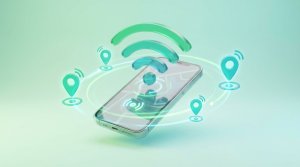
No app can turn a wall, table, or floor into a screen. The reason is straightforward: Projecting an image requires emitting light. directed towards the surface, the phone emits light only in front of its own screen, with enough power to be seen a few centimeters from the face.
But the idea behind the search is good, and there are real paths to get close to it. This text separates what is impossible from what works, along with the advantages and limitations of each option.
Why doesn't the cell phone project?
A projector needs three things: a powerful light source, a modulator that forms the image, and an optical assembly that focuses that image from a distance. The light needs to be strong enough so that the image survives ambient light after being spread over an area much larger than the original screen.
The phone has a backlit or emissive screen facing the person holding the device, and an LED flash without projection optics or a modulator. The flashlight illuminates, but it illuminates uniformly—it doesn't form an image.
There is also a question of scale. Spreading the same amount of light over a much larger area reduces the brightness proportionally. Even if there were optics, the available light would result in an image too faded to be seen outside of absolute darkness.
What do the apps in this category do?
- They simulate projection onto the screen itself. They use the camera to show the wall and overlay the image. on the display. Only the person looking at the phone can see it. Point it at a wall without the phone and there's nothing there.
- They promise "projector for photo". They ask for a photo of the surface and return a montage. It's image editing.
- They display advertisements. The real revenue model.
The previous version of this page listed five applications as if they were actual projection products. None of them existed. The list has been removed.
What works: a real projector
Miniprojetor portátil
About the size of a small speaker, with a battery and HDMI input or wireless mirroring. Affordable models already exist, and some run video applications directly, without needing another device.
What to look for when choosing: lumens, which define the brightness — below 200 it only works in the dark; real resolution, which is usually smaller than what is advertised as "supported"; and focus, It can be manual or automatic. It's also worth checking if it has distortion correction, which straightens the image when the projector isn't perfectly aligned.
Projetor de mesa e de teto
Some models project downwards, onto the table, or upwards, onto the ceiling. They don't make the surface interactive: they only display the image there.
Superfície interativa exige sensor extra
Systems that recognize touch on a projected surface combine a projector with an infrared camera or depth sensor, which detects the position of the finger. These are professional installations with dedicated hardware.
Alternatives that solve the same problem
It's worth asking what you really want. If the goal is simply to "view your phone's content on a large screen," there are simpler and cheaper ways to do it.
Espelhar na TV
The most practical option. A streaming device connected to the TV allows you to wirelessly send video and audio from your mobile phone. Current televisions usually have this feature built-in.

Cabo direto
A USB-C to HDMI adapter connects your phone to a TV or monitor. It works with devices that have a compatible video output — it's worth checking the model specifications before buying.
Realidade aumentada
Here the original promise comes closer to being fulfilled, with one essential difference: the image exists. on the cell phone screen, superimposed on the environment captured by the camera. Decorating apps that show furniture in your room, or camera-based measurement apps, use this and work well.
The limitation remains the same: only those looking through the device can see it. Nothing is projected onto the wall.
For writing and drawing on large surfaces.
If the intention was to use the wall as a whiteboard, there are better solutions: chalkboard paint, white adhesive film, or a regular whiteboard combined with a projector. For remote collaborative work, shared whiteboard apps truly solve the problem—each participant sees it on their own device, and the drawing is shared.
How to recognize an app that only pretends to design?
The promise is repeated so often that it's become a subgenre of app, and you can identify it in seconds. What these programs do is open the... rear camera, Apply a filter that mimics the yellowish light of an old projector and overlay the chosen image on the screen. You continue looking at your phone; the wall remains blank.
- Asks for camera permission. for a role that, if it were real, wouldn't require seeing anything.
- Instructs to turn off the light. from the environment and manually "focusing," which only makes sense for a photo.
- It carries an entertainment warning. in small print at the end of the store description.
- Show demonstration video Recorded with a real projector, not with the app.
- Charges a weekly subscription. before any test.
The physical reason is simple and definitive: projection requires a powerful light source, an optical system, and a light path out of the device. A cell phone has a screen that emits light towards the viewer and a diffused flash, without a projection lens. No application creates hardware that doesn't exist.
Choosing the right projector without falling for inflated prices.
When it comes to making a purchase decision, the technical specifications can be quite misleading, and it's worth knowing how to read them.
- ShineLook for the value in ANSI lumens, which is a standardized measurement. Generic numbers, much higher, are usually marketing ploys.
- Actual resolution Regarding "supported resolution": accepting a high-definition signal does not mean displaying it in that definition.
- EnvironmentThe more light in a room, the more brightness is needed. A bright room during the day requires much more brightness than a dark bedroom.
- Projection distanceEach template requires a minimum amount of space to form the image at the desired size.
- Noise and heat from the fan, which is more annoying than most people expect.
- Autonomy, In the case of battery-powered laptops, the battery usually lasts only a few hours.
Regarding the surface: a matte white wall works well; a colored wall alters the tone of the image, and a glossy wall creates glare. A simple projection screen improves contrast more than most people realize.
Step-by-step guide to projecting your phone image onto a large screen.
- 1. Decide how you want to view it: cable, wireless mirroring, or streaming to a device connected to the television.
- 2. When checking the cable, confirm that your device has a USB-C video output, as not all devices do.
- 3. For wireless connections, place your cell phone and receiver on the same Wi-Fi network and preferably use the five gigahertz band.
- 4. Enable the option in the Android quick menu, with names like Cast or Mirroring, or Screen Mirroring in the iPhone Control Center.
- 5. Adjust the screen rotation and brightness before you begin, and turn off notifications so they aren't displayed to the public.
- 6. If using a projector, focus and correct for distortion after positioning the equipment in its final location.
Common errors, limitations, and what the system already provides.
The most frequent mistake is buying a cheap projector expecting a television-quality image in a well-lit room. The second is using a congested Wi-Fi network and blaming the device for the frozen image. The third is expecting the projection to recognize touch on the wall: surface interaction requires a dedicated sensor, infrared camera, or specific pen, something that no app can provide on its own.
Without spending any money, your cell phone already solves a good part of the need. Android and iPhone have native mirroring for compatible televisions and receivers, many devices with USB-C deliver video directly via cable, and most video applications have a cast button to send content to the television without mirroring the entire screen — which saves battery and keeps the cell phone free.
Existe algum aplicativo que faz o celular projetar de verdade?
No. Without optics and a dedicated light source, there is no projection. Every app in that category is a camera with a filter or viewfinder.
E aquele acessório com lente e caixa de papelão?
It creates an enlarged and inverted image of the screen in a completely dark environment with very low brightness. It's a physics experiment, not a projector replacement.
Por que a tela fica preta ao espelhar um serviço de streaming?
For content protection. In this case, use the app's own cast button instead of mirroring the entire device.
Espelhar consome muita bateria?
It consumes a lot of power because it keeps the screen and radio active. Streaming only the video, leaving the phone just as a remote control, consumes much less.
In summary
Projecting an image requires emitting light, and cell phones don't have a light source or optics for that. Apps that promise this function show the overlay on the screen itself. For a truly large screen, the way to go is to mirror it on a TV, use a cable, or buy a mini-projector — in that order of cost and simplicity.
SEE MORE: